
HOLLY BERNATZ FOR MAYOR
Experienced servant leadership for Farmington’s next chapter.Farmington is at an important point in its history. The decisions we make about growth, infrastructure, taxes, public safety, and long-term planning will shape our community for years to come. Leading a city forward requires more than ideas for its future. It requires an understanding of where we've been, where we are, and what it will take to get where we want to go. The importance of current, firsthand experience cannot be overstated. Having served on the Farmington City Council for nearly four years, I understand the work already underway, the opportunities ahead, and how today's decisions will shape Farmington's future. I'm running for mayor to bring that experience and thoughtful leadership to the community we all call home. I invite you to learn more about my vision, connect and ask questions. I'd be honored to have your vote on November 3rd.
PRIORITIES
WHY MAYOR? WHY NOW?
Farmington is growing. The question is whether we guide that growth in a way that makes us stronger.My focus as mayor is clear: build a more balanced tax base, plan responsibly for infrastructure, use outside funding wisely, communicate plainly, support public safety and city staff, and make decisions with Farmington’s long-term future in mind.That is the work. And I am ready to lead it.
MY APPROACH TO LEADERSHIP
Understand the issue, the facts, and the broader implications.
Evaluate opportunities with both today's needs and tomorrow's priorities in mind.
Balance competing priorities by weighing resident feedback, financial realities, infrastructure needs, public safety, and long-term community goals, while keeping the whole city in focus.
Plan for Farmington's long-term success, not just the next decision.
Communicate openly so residents understand not only the decision, but the reasoning behind it.
14 WEEKS OF FARMINGTON QUESTIONS
A weekly video series covering local government, city priorities, resident questions, and the decisions shaping Farmington’s future.


A STRONGER, MORE BALANCED TAX BASE
Farmington has relied too heavily on residents to carry the cost of city services, infrastructure, and growth. That is not sustainable long term.One of the most important things we can do for residents is continue building a stronger, more balanced tax base. We can achieve this by supporting existing businesses, attracting new investment, encouraging redevelopment, and making Farmington a community where businesses want to locate and grow.During my time on City Council, I've been part of a much more deliberate effort to strengthen Farmington's economic development strategy. We've spent time looking at the data, building relationships, talking with businesses, and better understanding what has kept certain types of development from coming to Farmington. We've strengthened partnerships with Minnesota DEED, Open to Business, Dakota County, Dakota County Technical College, Inver Hills Community College, and other regional organizations. We've increased outreach to businesses and site selectors, held a Business Summit and Small Business Resource Fair, conducted business surveys, offered EDA grants and assistance programs, and completed a grocery market analysis to better understand what it will take to attract more of the services residents have been asking for.One thing I've learned through my experience is that attracting businesses isn't as simple as having land available and wanting them to come. Businesses look at population, workforce availability, infrastructure, traffic, surrounding development, and whether a community can support their investment. That's why housing development, including projects like The Emery and The Rye, is also part of the bigger picture. The more we understand what businesses are looking for, the better prepared we are to compete for those opportunities. Responsible economic development requires looking at the full picture; the financial return, infrastructure needs, community fit, and long-term value; before deciding whether an opportunity moves Farmington forward. Careful does not have to mean closed. Responsible does not have to mean afraid of change.There is still a lot of work to do, but we're making progress. I want to continue that work as mayor, building on the relationships we've established, the information we've gathered, and the investments already taking shape. A stronger commercial and industrial tax base helps us pay for the services and infrastructure our community needs without continuing to place so much of that responsibility on homeowners. A stronger business community is not separate from quality of life. It is part of how we fund and protect it.
INFRASTRUCTURE, GRANTS & GOOD STEWARDSHIP
Infrastructure is not glamorous, but it is one of the most important responsibilities of city government.Cities age just like homes, vehicles, and people do. Roofs wear out. Roads crack. Trails deteriorate. Equipment reaches the end of its useful life. Buildings need repairs. Water, sewer, and stormwater systems need care. Public safety needs change as a community grows. Most of us understand this in our own lives. If we ignore the roof, skip vehicle maintenance, or avoid a health concern, the problem usually does not get cheaper. It gets bigger, more urgent, and more expensive. Cities are no different.During my time on Council, I have supported Farmington’s use of tools such as our five-year Capital Improvement Plan, road and trail Pavement Condition Index ratings, park maintenance data, equipment replacement schedules, utility planning, and Facility Condition Assessments to guide decisions. These tools help us understand what needs attention, when it needs to happen, and how we can plan for it responsibly. They also help remove emotion and guesswork from major decisions.The Facility Condition Assessment, for example, gave us objective information about the condition of the Rambling River Center and the work the building required. That same discipline is important as we consider the Police Department’s long-term facility needs.The same approach should guide decisions about roads, trails, parks, utilities, equipment, and public buildings. We should not wait until something fails or make major investments simply because an issue feels urgent in the moment. I have supported using condition data, long-term planning, and financial forecasting to set priorities. As mayor, I will continue that work so Farmington can address needs deliberately rather than moving from one crisis to the next.Responsible planning also includes pursuing grants when they help fund projects Farmington already needs. Since 2023, Farmington has accepted significant state and federal funding, including:
$750,000 for the Rambling River Center and exterior plaza rehabilitation
$869,000 for Police Department perimeter security and related infrastructure
$500,000 for Emerald Ash Borer tree removal and replanting in the downtown project area
$350,000 for development of a new skatepark
That amounts to $2.469 million in confirmed state and federal grant funding brought back to Farmington for community needs.Grant funding is an important tool because our residents and businesses already pay into these systems. When appropriate funding is available for work Farmington needs, we should compete for it. Used wisely, grants can move important projects forward without placing the entire burden on local taxpayers.Still, grants are not a golden ticket. Before accepting funding or approving a project, we must also understand what follows. What will it cost to operate and maintain? Will additional staffing be needed? How will it eventually be repaired or replaced? Does it fit within the city’s long-term priorities and financial capacity?I have supported pursuing outside funding while accounting for the obligations that come with it. I will continue seeking responsible opportunities for Farmington without ignoring the future cost of maintaining what we build. Fiscal responsibility is not simply saying no to spending. It is knowing the condition of what we own, planning before things fail, using outside funding wisely, and making sure today’s investments do not become tomorrow’s unfunded problems.
PLANNING FOR 2050, NOT JUST NEXT YEAR
The 2050 Comprehensive Plan continues to be one of the most important pieces of work in front of Farmington.A comprehensive plan is the city’s land-use guide. It helps determine where housing makes sense, where businesses can grow, where redevelopment could happen, where roads and utilities need to be planned, and how public safety, parks, trails, and city services may be affected over time. This affects residents because growth is connected to everything: taxes, traffic, utilities, staffing, neighborhoods, public safety, infrastructure, and quality of life.I also believe it is important to be honest about how these plans work. A comprehensive plan should provide clear direction, but it is not meant to freeze a city in place for 10, 20, or 30 years. Communities, market conditions, infrastructure needs, housing needs and business opportunities can all change. We need to be both forward thinking and adaptable to all of these possibilities. That does not mean mid-cycle amendments should be taken lightly. Any proposed change to the land-use plan should be reviewed carefully, publicly, and with a clear understanding of the impacts. The question should always be: does this change help Farmington become stronger, more balanced, and better prepared for the future?During my time on Council, I have supported using the comprehensive plan as a guide for responsible growth, infrastructure planning, housing options, business development, redevelopment, and tax-base diversification. I have also supported looking at how today's decision affects tomorrow's Farmington:
What infrastructure is needed?
What does this require from staff and public safety?
What roads, utilities, parks, and services will be affected?
What is the long-term return to the city?
How does this affect residents?
Does this help create a stronger and more balanced Farmington?
As mayor, I will continue to support long-range planning that is clear, transparent, and grounded in the real needs of the city. I will continue to take proposed land-use changes seriously, not as automatic yeses or automatic noes, but as decisions that must be measured against Farmington’s long-term financial health, infrastructure capacity, neighborhood impact, and quality of life. Farmington needs leadership willing to look at the full picture.
CLEARER COMMUNICATION
This is an area that I will openly admit needs improvement. Residents deserve more than slogans and sound bites, especially during campaign season when anyone can, and often will, say anything to get your vote. You deserve to know what is being considered, why it is important, what the tradeoffs are, and how decisions may affect taxes, services, neighborhoods, and the future of the city.City government will never be simple, and not every decision can or should become a ballot question. That is not how representative democracy works. Residents elect leaders to study the issues, evaluate the facts from every angle, weigh competing needs, and make decisions on behalf of the whole community. Making decisions on behalf of the community also carries a responsibility to communicate clearly. When it comes to communication, the real questions are:
Is the information available for residents who seek to understand it?
Can it be found without digging through layers of confusion?
Can it be understood by someone who does not work in city government?
Are we using the right tools to connect with residents in ways that are actually helpful?
As mayor, I will continue my focus on making city information easier to find, easier to understand, and easier to engage with. That means better access to the “what, why, and how” behind decisions, more plain-language communication, and more opportunities for residents to ask questions and be heard. It also means recognizing that meaningful engagement cannot rely only on social media. Social media can be useful for sharing information, but it is not always the best place for thoughtful conversation, careful listening, or respectful problem-solving.I will continue Mayor Lien’s office hours initiative because residents deserve opportunities to connect, ask questions, share concerns, and have conversations outside of a formal council meeting or comment thread. My commitment is to continue listening, answering questions directly, explaining the reasoning behind decisions, and keeping residents connected to the work happening in Farmington.
SUPPORTING THE PEOPLE WHO SERVE FARMINGTON
This is a priority that was added during my first few months on Council, and it is one I am proud to support. Farmington is served by skilled, dedicated staff who do the daily work residents rely on and countless services most people only notice when something goes wrong.Supporting staff means asking difficult and often complicated questions with respect, setting clear expectations, and making sure the people doing the work have the tools, direction, and professional environment they need to serve residents well.Elected leaders come and go. That is part of a healthy democracy. But the city organization must remain strong, stable, and focused on service. As mayor, I will continue to support city staff while representing the needs, concerns, and expectations of Farmington residents.
Who is Holly?
I was raised on a dairy farm in Central Minnesota, where hard work was part of daily life. Driving tractor, milking cows, picking rock, and putting up hay taught me responsibility, discipline, and the value of doing what needs to be done. That upbringing continues to shape the way I work, serve, and lead.Service has also been part of my life for as long as I can remember. From helping start a children's choir in my hometown church to teaching religion classes, serving in worship, and participating in mission work in Haiti, India, and Tanzania, I've always believed in finding ways to give back.I graduated from Paynesville High School in 1997 and earned a Bachelor of Arts in Philosophy from the College of Saint Benedict in 2001. My education taught me to think critically, consider different perspectives, and work through complex issues before reaching a conclusion. Those skills have served me well, both personally and professionally.In 2003, I married my husband and best friend, Scott. More than 22 years later, we're raising our family in a community we love. Our daughter, Ava, is a junior at Drake University, and our son, Grant, is a senior at Farmington High School. We also have two poodles, Navee and Micah, who keep life interesting!After Ava was born, I left my corporate career to start a small business. Today, I own and operate two businesses. Being a business owner has taught me a great deal about working with people, managing finances, solving problems, and taking responsibility for the decisions I make.Our family moved to Farmington in 2012, and it quickly became home. I became involved in our schools, supported choir, theater, and athletic boosters, organized National Night Out in our neighborhood, volunteered with Dew Days and Toys for Town, and helped raise funds for the American Cancer Society and a local veterans organization. I've always enjoyed being involved in the community and getting to know the people who make it such a special place.In November 2022, I was elected to the Farmington City Council. Over the past nearly four years, I've gained firsthand experience with the issues facing our city, including infrastructure, public safety, economic development, redevelopment, and long-term financial planning. I've been part of important discussions and decisions, and I'm proud of the work we've accomplished, including securing state and federal grants that help fund community projects without placing the full cost on local taxpayers.Serving on Council has reinforced something I've believed for a long time: good decisions require taking the time to understand the facts, listen to different perspectives, ask questions, and consider how today's choices will affect our community in the years ahead. Not everyone will agree with every decision, but I believe residents deserve to know their concerns have been heard and their elected officials have done the work necessary to make informed decisions.I believe Farmington has a great deal of opportunity ahead of us. We also have important work to do. My experience on Council has given me a clear understanding of where we are today, what is already underway, and what it will take to keep moving forward.Farmington is a community worth investing in. I'm proud of what we've accomplished together, excited about what's ahead, and would be honored to earn your vote for Mayor on November 3rd.


HOW YOU CAN HELP
My campaign is about conversations, connection, and people who care about Farmington’s future.
You can help by requesting a yard sign, talking with neighbors and friends, asking questions, staying informed, voting, and encouraging others to vote.
Local elections are vitally important. I am grateful for your support.
FREQUENTLY ASKED QUESTIONS
There is a lot happening in Farmington. I believe residents should be able to find clear answers without having to search through meeting packets, social media threads, or hours of video. These are some of the questions I hear most often. If you have a question that isn't answered here, please reach out. I am always happy to connect directly.
LEADERSHIP & APPROACH
Why are you running for Mayor?
Farmington is in an important season of growth and change. Decisions about infrastructure, public safety, development, taxes, services and long-range planning will affect our community for decades. I am running because I believe my experience on City Council, as a small-business owner and as someone who has been deeply involved in this community gives me a strong understanding of both where Farmington has been and the decisions ahead. My priorities are a stronger and more balanced tax base, responsible infrastructure planning, public safety, thoughtful growth, clearer communication and support for the people who serve our city. Those are also the priorities reflected throughout my campaign website.What do you believe the role of Mayor should be?
Farmington operates under a mayor-council form of government with a full-time City Administrator responsible for day-to-day operations. The Mayor and Council set policy, adopt the budget and levy, consider land-use matters, approve contracts and make decisions on behalf of the community. I believe the Mayor's role is to lead the Council well, understand the issues, ask good questions, work respectfully with staff and other elected officials, communicate clearly with residents, and keep the long-term interests of the entire community in view. The Mayor does not run individual City departments. Good leadership requires respecting the professional roles of the people hired to do that work.What does “responsible growth” mean to you?
Growth is not automatically good or bad. I look at what a proposal contributes, what infrastructure it requires, how it affects surrounding neighborhoods, what responsibilities it creates for public safety and City services, its financial return to the community, and whether it fits Farmington's long-term plans. Farmington's 2050 planning work is vital because decisions about housing, commercial development, roads, utilities, parks and services are connected. A comprehensive plan should provide direction while still allowing a city to respond thoughtfully to changing conditions.How do you listen to residents and gather input?
I listen to residents in many ways, through face-to-face conversations, emails, phone calls, public meetings and social media. Residents have great ideas and their input often makes projects and decisions better. People who live in a neighborhood, use a park, drive a road, own a business or interact with a City service bring perspectives that staff and elected officials may not see on their own. That input helps us better understand community needs, identify concerns, recognize opportunities and learn what residents value as Farmington grows and changes. Listening also does not always mean agreement. Residents can raise thoughtful and valid concerns, and elected officials can take those concerns seriously while still reaching different conclusions after considering the full picture. My responsibility is to listen, ask questions, gather information, consider professional analysis and weigh the needs of the community as a whole before making a decision.What does “supporting City staff” mean?
Supporting staff does not mean agreeing with every recommendation. It means asking difficult questions respectfully, setting clear expectations, giving employees the tools and direction they need, and maintaining a professional environment where people can do their jobs well. Elected officials come and go. A healthy City organization needs professional continuity, accountability and mutual respect. That is one of the priorities I have consistently identified throughout my service.Are you accepting endorsements?
I chose not to seek or accept organizational endorsements for this campaign. I respect organizations, workers, businesses and community groups that participate in the civic process, but I want residents to know that my responsibility as Mayor would be to the entire community. I want people to evaluate me based on my experience, record, approach to leadership and the information I provide throughout this campaign.How would you strengthen the relationship between the City of Farmington and the Farmington School District?
I want the City and School District to be partners who celebrate each other's successes, work through challenges together and share a genuine commitment to making Farmington a community where people of all ages can thrive. To do that, I'd like to see more consistent collaboration through regular communication, scheduled meetings, and more opportunities to show up and serve our community together. We shouldn't only be talking when there's a problem to solve. The City and School District have different responsibilities, but we're serving the same community. When families choose where to live, they're looking at the whole picture. A strong school district and a healthy local economy go hand in hand. I'd love to see more connections between our schools and local businesses, helping our young people see Farmington as more than just the place they grew up. I want them to see it as a place where they can build a career, start a business, raise a family and give back someday. Part of that is changing our narrative. We have challenges, and we need to address them. But if we're constantly focused on what's wrong, we lose sight of what's right and what we can accomplish together.What is your political affiliation?
Council positions are nonpartisan. We do not run under a political party label. My responsibility as a council member and your potential future mayor is to evaluate the issue in front of me and make the decision I believe best serves Farmington. Having said that, the lens through which someone views the world will still have an effect on their decisions. I am more conservative when it comes to fiscal responsibility, budgeting and the long-term financial obligations we take on as a city. I also firmly believe good ideas come from different perspectives and worldviews. Personally, I consider myself moderate and not strongly aligned with either major political party. I’m interested in the individual person, their experience, their character and where they stand on the issues.
CITY FINANCES & INVESTMENT
Why do you talk so much about the tax base?
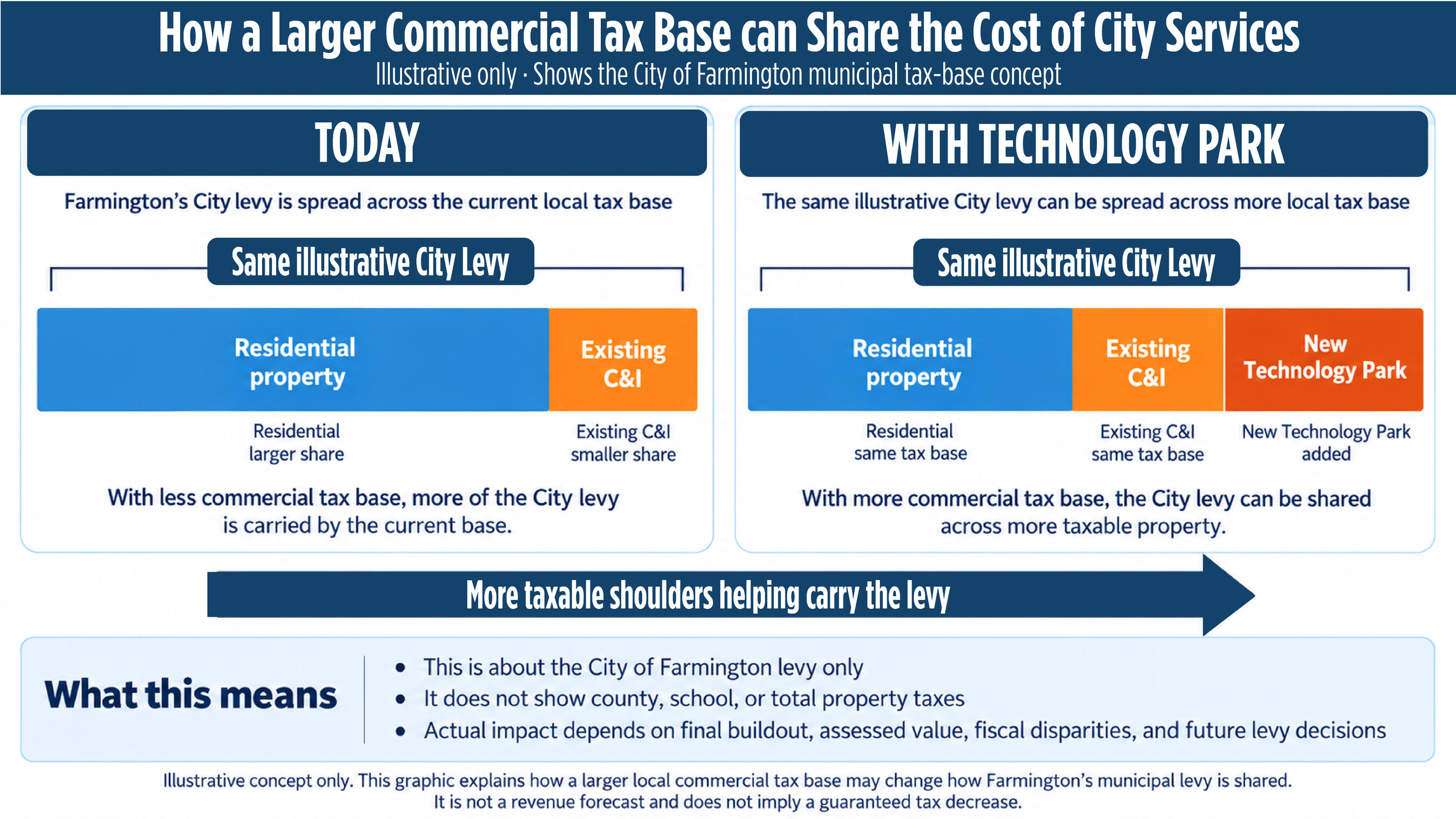
Farmington relies heavily on residential property taxpayers to support City services and infrastructure. Building a stronger commercial and industrial tax base does not eliminate property taxes, but it can broaden the base supporting community needs. That is why I support business retention, redevelopment, quality commercial and industrial growth, and creating the conditions that make Farmington competitive for investment. Economic development still has to make sense. Financial return, infrastructure needs, community fit and long-term costs are all part of the equation.What is the CIP, and does Farmington really have $74.5 million in needs?
For years, Farmington delayed maintenance, repairs, and replacement of important infrastructure and facilities. While putting off these expenses may have helped keep costs down in the short term, those needs didn't go away. In many cases, they've become more expensive. Over the past six years, the City has been actively working to address these needs, which is why residents are now seeing long-awaited projects and improvements getting done. We've made significant progress, but there is still more work ahead. Farmington's Capital Improvement Plan (CIP) helps us understand the full picture. The current 2027–2031 plan identifies approximately $74.5 million in capital needs, including streets, water, sewer, stormwater, equipment, buildings, parks, and other infrastructure. That is not a $74.5 million tax increase. It's a five-year planning document that identifies projects, anticipated costs, timelines, and potential funding sources. We can't fix everything at once, nor can we afford to return to putting off necessary investments. That's why I believe it's so important to use pavement-condition data, facility assessments, equipment replacement schedules, and long-term financial planning to prioritize what needs attention, determine when it should happen, and understand how we'll pay for it. The decisions we make today need to account for both the needs of our community now and our ability to maintain those investments in the future.Do you support using grants to help fund City projects?
Yes. I see grants as an important tool for helping Farmington meet community needs without placing the full cost on local taxpayers. Grants are not only used to build something new. They can help rehabilitate existing facilities, address unexpected expenses, improve public safety, and maintain assets we already have. Farmington received a $750,000 federal grant for rehabilitation of the Rambling River Center and exterior plaza, and grants to help manage Emerald Ash Borer, including tree removal and replanting. The Police Department perimeter security project is another good example. Farmington received an $869,000 federal grant that covered the estimated full cost of the security fence project, protecting critical infrastructure. As we consider our needs, I believe we should continue looking for grants and partnerships that can reduce the amount Farmington residents ultimately have to fund. At the same time, we still need to understand any required local match and what the ongoing operating, maintenance and replacement costs will be after the grant dollars are spent.What does fiscal responsibility mean to you?
A growing city has expanding needs related to infrastructure, public safety, staffing, facilities and services. As someone who is fiscally conservative, this means taking care of what we already own, planning beyond the next budget year, pursuing grants and partnerships when they make sense, growing and diversifying the tax base, and understanding both the immediate and long-term cost of the decisions we make. It also means not deferring necessary maintenance because it is easier in the short term. Years of previously delayed maintenance has become a much more expensive problem left for us to address now. My focus is to use every tool available, including outside funding, while making sure Farmington can afford to maintain what we build and responsibly meet the needs we have.
DATA CENTER
What benefit could the data center bring to Farmington residents?
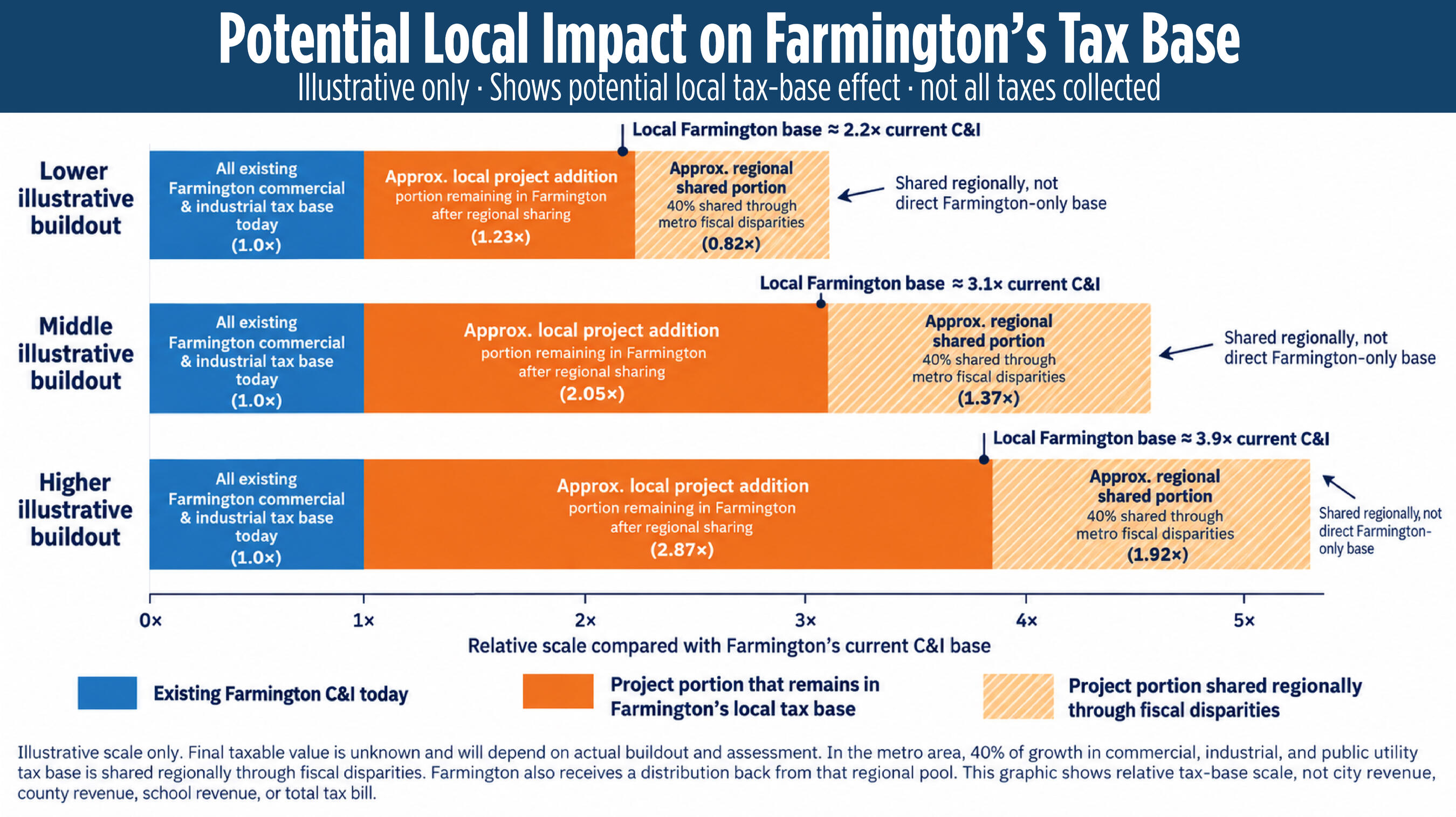
The biggest potential benefit is strengthening and diversifying Farmington's tax base. A significant commercial or industrial development adds property value that helps share the cost of City services and long-term infrastructure with our residential tax base. There is also the potential for permanent jobs, construction and skilled-trade work, development fees and investment in infrastructure. In its 2024 presentation, Tract projected approximately 277 permanent jobs at full build-out, including positions in areas such as IT, engineering, HVAC, electrical work and security. That is a developer projection, not a guarantee. In addition, a development of this scale has the potential to add significant commercial and industrial property value to Farmington’s tax base. I've created illustrations based on available public data to help explain the possible financial benefit. The exact tax impact will depend on what is ultimately built, its assessed value and the tax laws in place at that time. That potential community benefit is one of the reasons I have supported allowing the project to continue through the review process. While the potential benefits are significant, they do not eliminate the responsibility to evaluate impacts such as water, noise, infrastructure, public safety and the surrounding neighborhoods before specific development moves forward.
Has there been a tax abatement request?
There has been no formal City of Farmington property-tax abatement application, no TIF request for the Technology Park, and no City Council approval of either one. The 2024 development contract does not contain a tax-abatement or TIF provision, and the City Attorney's April 2026 summary of the revised development contracts does not identify one either.Did you sign an NDA for the Technology Park?
No. I was never asked to sign an NDA for this project, and I did not sign one. I have never been asked to sign an NDA for any City economic-development project.Did you receive any personal financial benefit from the data-center project?
No. I have received no personal financial benefit from this project. My votes and decisions as a Councilmember have been made in my public role as an elected official.What protections are in place for nearby properties?
The Technology Park has several protections already in place intended to reduce impacts on neighboring homes should development move forward.
Current requirements include:
- 500-foot minimum building setbacks from adjacent residential property lines
- 20-foot berms
- 6-foot privacy fencing on top of the berms
- Evergreen and coniferous screening expected to grow about 15–25 feet
- Additional 40 to 80-foot natural buffer areas in the approved PUD
-Annual water-use limit of 50 million gallons for the entire Technology Park campus. For comparison, the two existing irrigation wells on the property, previously used for the golf course and agricultural land, had DNR water appropriation permits allowing up to 48.6 million gallons annually.
- Specific exterior lighting restrictions
- Construction-hour limits
- Noise studies and compliance with applicable Minnesota noise standards
- A 65-foot maximum building height
The final site plan will also determine building placement, mechanical equipment locations, landscaping, screening, traffic circulation and other details that may affect nearby properties.Why don't we know the final end user, buildings or timeline yet?
Because the project has not reached that stage. The City Attorney's April 2026 memorandum states that the development was always anticipated to occur in phases and that, beyond the limited first phase, the exact timing and details of future phases remain unknown. Future activity is subject to additional site-plan and development review. That means some questions residents are asking are completely reasonable questions, but they cannot honestly be answered until there is an actual project-specific proposal to evaluate.Who decides whether the technical impacts of a project are acceptable?
That work involves both elected officials and professionals, but we have different roles. Residents bring important knowledge about their neighborhoods and homes. Their questions help identify what matters to the community. Technical questions involving things such as noise, groundwater, wetlands, stormwater, utilities, air quality and infrastructure require review by qualified professionals and, depending on the issue, City engineers and planners and county, regional or state agencies. I am not a hydrologist, acoustical engineer, groundwater scientist, electrical engineer or air-quality expert. I do not believe elected officials should pretend to be. Our job is to make sure the right questions are asked, the required professional reviews occur, resident concerns are understood, and decisions are then made using that information.What could the Technology Park mean for nearby property values?
There is credible research documenting positive associations and broader economic benefits, credible research finding no measurable housing-price effect, and credible research identifying localized negative effects. That makes it inappropriate to claim either that a data center will inevitably damage nearby home values or that it will necessarily increase them. For Farmington, the important question is whether this particular project, with its design and enforceable protections, can produce a meaningful long-term community benefit while minimizing the potential impact on neighboring homeowners. National Association of REALTORS®- 2026, Princeton University- April 2026, George Washington University- 2026, NBER- 2026, Realtor.com- August 2026, UC Berkeley / Harvard / Monash- 2026, George Mason University- August 2025, University of Rochester- March 2026How does City Council make decisions about proposed developments? Can personal opinions influence those decisions?
As residents, we all have personal opinions about businesses, industries and development. I'm no different. For example, as a graphic designer, I've seen firsthand how generative AI is changing my industry and affecting the work I've spent more than 20 years building. I have personal concerns about that. But those feelings alone cannot be the basis for whether a particular development should be approved or denied. The council and mayor's responsibility is to evaluate proposals through the appropriate process, using our Comprehensive Plan, zoning ordinances, land-use requirements, applicable laws and established standards. That means considering things like infrastructure capacity, traffic, environmental impacts, public safety, compatibility with surrounding properties and protections that can be legally required and enforced. Resident input is also important and makes for better outcomes. Residents help us identify concerns, ask better questions and determine whether proposals adequately address potential impacts. Still, there is a difference between my personal opinion about a business or industry and determining whether a specific project meets the requirements for development. Some decisions involve broader policy choices, while others require us to apply existing standards to a particular application. In either case, decisions need to be supported by the applicable facts, laws and responsibilities of the City. My job isn't to make decisions based solely on what I personally like or dislike. It's to make informed, defensible decisions that consider Farmington as a whole. A development should stand or fall on its merits, through a fair and thorough review process.Did Farmington approve a final 2.53-million-square-foot data center?
No. A final site-specific data-center development application is not currently pending before the City Council. The 2.53-million-square-foot figure comes from one of the development scenarios evaluated in the AUAR. The AUAR specifically evaluates potential impacts at that scale. A representative layout also considered up to 12 data-center buildings and two administrative buildings. That representative plan is important, but it is not the same thing as approved construction plans for twelve specific buildings. The City's 2026 development-contract memorandum states that future phases beyond the limited initial phase remain subject to site-plan review and a Site Improvement/Performance Agreement. The City's current Technology Park page also states that no specific development proposal is presently before the Council.What is your position on the Farmington Technology Park and proposed data center?
I believe every development proposal deserves a fair, thorough review based on its merits, not simply personal opinions about an industry. The Farmington Technology Park represents a potentially significant economic-development opportunity, but that doesn't mean any proposed development automatically deserves approval. My position has been to allow the project to proceed through the established review process, where it must be evaluated against applicable laws, zoning requirements, land-use standards and enforceable protections. That includes carefully examining potential impacts on water, electricity, noise, traffic, the environment and surrounding properties. Residents' concerns are an important part of that process and help identify issues requiring further scrutiny. Ultimately, any potential project must demonstrate that it can meet the applicable requirements. Allowing a proposal to move through the review process is not a guarantee of approval. I've covered the project's history, my position and the remaining steps in two detailed videos available on my homepage.
19HA-CV-25-992 (current)
19HA-CV-24-5838 (original)
PUBLIC SAFETY & COMMUNITY ISSUES
How do you approach public safety?
Public safety starts with making sure our Police and Fire Departments are prepared to serve a growing community. That means planning ahead for staffing, facilities, equipment, training and the changing demands placed on first responders. It also means listening to the professionals doing the work every day and using data to understand what they need, rather than reacting only when something becomes urgent. My role as Mayor would not be to manage the Police or Fire Departments. It would be to make sure the City is planning responsibly, providing the resources necessary to do the job well, and supporting the people we ask to respond when our community needs them most.Do you support franchise fees to help fund the Police Department expansion?
The funding mechanism is still being developed. I support considering a utility franchise fee as a funding tool for the Police Department remodel and expansion. The current proposal is for franchise-fee revenue to be used to make the annual debt payments on the bonds issued for the Police Department project. Under the structure currently being considered, the proposed residential fees are $6 per month for electric service and $6 per month for gas service, or $144 annually for a residential customer with both services. One reason the City is considering this option instead of putting the entire project on the property-tax levy is that franchise fees are paid by utility customers, including some users who do not directly pay property taxes. The City’s analysis also says that about 71% of Farmington homes would see a property-tax increase greater than $144 annually if the project were funded through the levy instead. The Police Department building was constructed in 2002 for a department of about 16 employees. Today the department has about 32 employees, while Farmington’s population has grown from roughly 14,000 to about 25,000. The City has identified the remodel and expansion as a strategic priority because the existing facility no longer meets current staffing, equipment and operational needs.Does Farmington have Flock cameras?
No. Farmington does not currently have Flock Safety cameras. “Flock” is a brand name. Flock Safety is one company that sells automated license plate reader systems, commonly called ALPRs. These systems capture information such as a license plate number, vehicle image, date, time and location. Minnesota law places significant restrictions on how law enforcement can use ALPR data. Access is limited to authorized personnel for a legitimate, documented law-enforcement purpose, and searches must be tied to reasonable suspicion that the information is relevant to an active criminal investigation. Searches and access are also logged. A warrant is required if law enforcement wants to use an automated license plate reader to monitor or track a specific individual who is the subject of an active criminal investigation, unless exigent circumstances apply. If Farmington were ever to consider Flock or another ALPR system, I believe residents should know exactly what technology is being proposed, why it is needed, what information it collects, who can access it, how long data are retained and what safeguards are in place before a decision is made.What is your position on e-bikes and e-scooters?
E-bikes and e-scooters can be a useful way for residents to get around, but they also need to be operated safely and within Minnesota law. Farmington has already published guidance because the City has seen electric bikes, scooters and similar devices being used illegally or unsafely on streets, sidewalks and trails. The City’s page summarizes the state requirements for electric-assisted bicycles and motorized foot scooters. My approach is to start with education and enforcement of the laws already in place. If Farmington continues to see safety problems, particularly involving speed, young riders, sidewalks, trails or devices that do not legally qualify as e-bikes, then the City should look carefully at what additional local tools are actually available and whether they are needed. The goal should not be to prohibit a useful form of transportation because some people use it irresponsibly. It should be to make sure residents understand the rules, that unsafe behavior is addressed, and that our streets and trails remain safe for everyone.
CAMPAIGN & CONNECTING
What is the best way to have a conversation with you about an issue?
I use social media to share information, but I believe policy conversations are often better when people can ask questions, hear the full answer and have a back-and-forth conversation. I’m available by email and phone, for one-on-one meetings, conversations with a few friends or neighbors, and small-group discussions. My website also includes a direct meeting option and question form. My goal is to make it easy for residents who want to connect with me to do so. You can call or text me at 320-224-4594. My campaign email is [email protected]How can I learn more or talk with you directly?
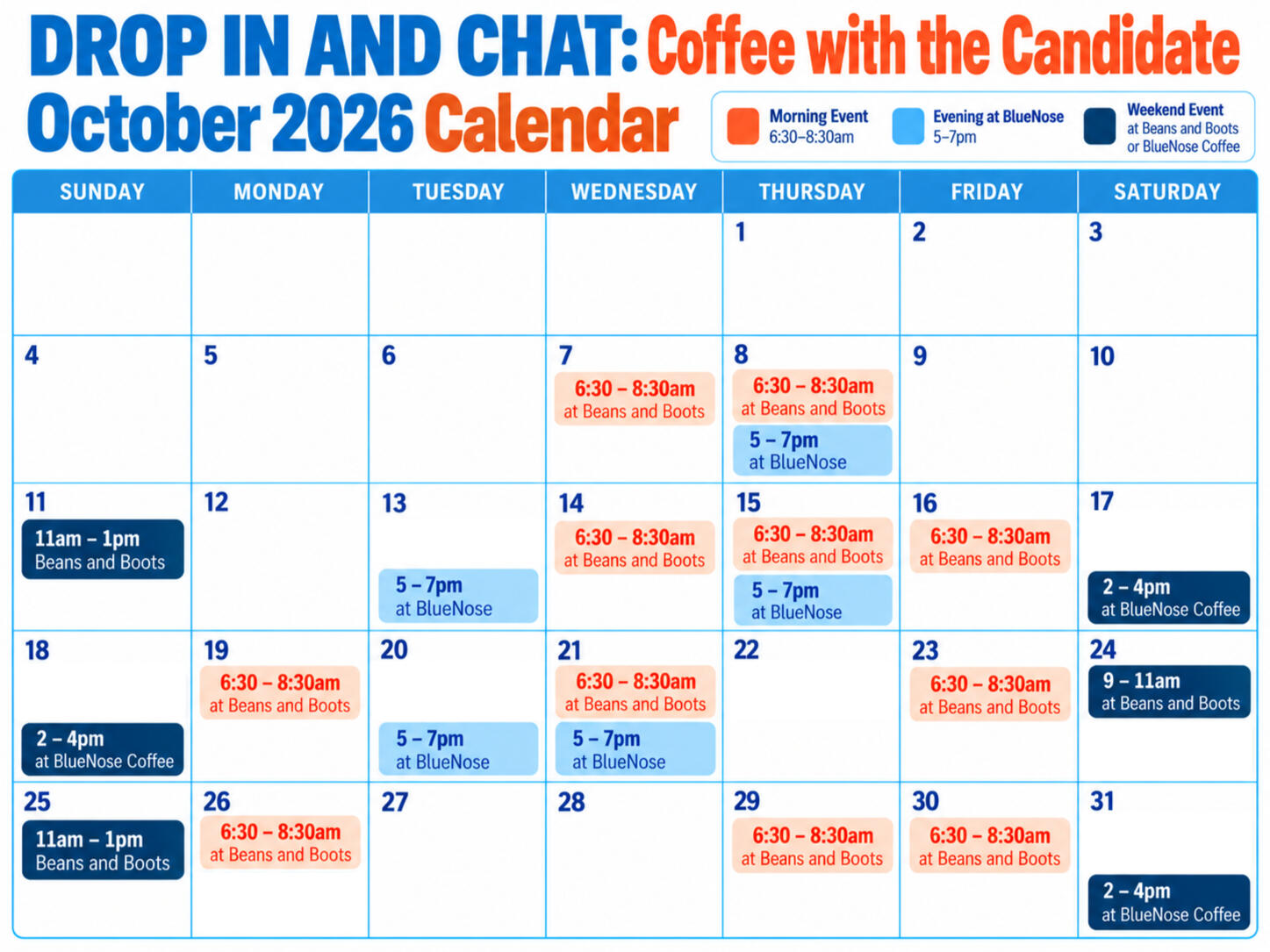
You can explore the issue pages and weekly 14 Weeks of Farmington Questions videos on this site, watch the candidate forum, submit a question, or schedule a conversation with me through the website. I have also added additional opportunities for informal in-person conversations. You can find those days and times on my Facebook page under events.When is the election?
Farmington's General Election is Tuesday, November 3, 2026. Polls are open from 7 a.m. to 8 p.m. The City also provides absentee and early-voting options before Election Day.